


You wake up and your lashes are stuck together. By mid-afternoon your lids feel hot and gritty. In every photo lately, your eyes look tired or irritated even when you feel fine, and the contact lenses you wore comfortably for years have started to feel like a negotiation.
If you have quietly wondered whether your eyelids look strange to other people, you are not alone, and there is nothing to be embarrassed about. This is one of the most common conditions eye care professionals see.
Blepharitis is inflammation of the eyelids—typically the eyelid margins, where the lashes and oil glands sit. It causes redness, irritation, crusting, and flaking along the lash line. Blepharitis is common, chronic, and manageable with consistent daily care, though symptoms often return if that care stops.

This article explains what eyelid inflammation actually is, what causes it, what blepharitis treatment realistically involves, and what to expect over time. It also answers the question most people arrive with—can this be cured?—directly rather than dodging it.
Between screen-heavy days and families rebuilding routines, lid discomfort tends to get noticed and then filed away for later. Here is what is actually happening on your eyelid, and why the type matters.
What Is Blepharitis? Anterior vs. Posterior Explained
Blepharitis is chronic inflammation of the eyelid margin, affecting the lash follicles, the eyelid skin, or the meibomian glands that produce the oil layer of your tears. It occurs in two main forms—anterior blepharitis, affecting the outer lash line, and posterior blepharitis, affecting the inner lid margin—and the two frequently overlap.
That distinction is not academic. According to the American Academy of Ophthalmology’s Blepharitis Preferred Practice Pattern, distinguishing anterior from posterior blepharitis helps guide targeted therapy. Knowing which part of your lid is involved is what turns generic advice into a plan.
Anterior blepharitis affects the outside of the eyelid, at the base of the lashes and within the lash follicle itself. It is associated with Staphylococcus overgrowth, seborrheic causes that often travel with scalp and eyebrow dandruff, allergies, and Demodex folliculorum mites living in the follicles. Its signature is visible: crusting at the lash base, lashes that stick together, and irritation that is worst first thing in the morning.
Posterior blepharitis affects the inner lid margin, where the meibomian glands and their ducts open. It is driven primarily by Meibomian Gland Dysfunction—the glands become obstructed and the oil they produce changes in quality, which destabilizes the tear film. It is commonly linked to rosacea and may involve Demodex brevis, which lives in the sebaceous and meibomian glands rather than the lash follicles. Its signature is different: burning, dryness that builds as the day goes on, tears that look oily or foamy, and redness along the lid edge. If tear film instability is the dominant part of your experience, that connection is covered in depth in our dry eye guide, and the gland mechanics themselves are the subject of our Meibomian Gland Dysfunction guide.
| Feature | Anterior Blepharitis | Posterior Blepharitis |
|---|---|---|
| Location affected | Outer lid skin, lash base, lash follicle | Inner lid margin, meibomian glands and ducts |
| Main causes | Staphylococcus, seborrheic dermatitis, allergy, Demodex folliculorum | Meibomian Gland Dysfunction, rosacea, Demodex brevis |
| Common symptoms | Crusting, sticky lashes, flaking, morning irritation | Burning, dryness worsening late in the day, oily or foamy tears |
| Most-emphasized frontline care (per AAO) | Eyelid cleansing and lid margin hygiene | Warm compresses and lid massage |
One important caveat before you decide which column is yours: many people have both. Mixed blepharitis is common, and seeing yourself in both descriptions is not a sign you have misread the situation. It is one of the most frequent presentations there is.
Now that you know what is happening structurally, here is how it tends to show up in daily life.
What Does Blepharitis Look and Feel Like? Common Symptoms
Blepharitis looks like red, swollen eyelid margins with crusting or flaking at the base of the lashes, greasy scales along the lid edge, and lashes that stick together overnight. It feels like burning, itching, grittiness, a foreign-body sensation as though something is caught in your eye, and sensitivity to light.
The most commonly reported signs and sensations include:
- Red or swollen eyelid margins
- Crusting or flaking at the lash base
- Lashes stuck together on waking
- Burning or stinging
- Itching along the lid edge
- Gritty, foreign-body sensation
- Watery or unusually dry eyes
- Light sensitivity
- Lashes that grow in odd directions or fall out
- Contact lenses that feel less comfortable than they used to
Two terms worth knowing, because an eye care professional may use them: collarettes and cylindrical dandruff. Both describe the same clinical sign—waxy cuffs that wrap around the base of a lash like a tiny collar. They are not ordinary flaking, and their presence is a meaningful pointer toward Demodex involvement.
The timing tells you something. Anterior symptoms are usually worst on waking, when debris has collected overnight. Posterior symptoms usually build through the day, as an unstable tear film loses ground hour by hour. Which half of the day is worse is genuinely useful information to bring to an appointment.
A few adjacent experiences also belong here: vision that blurs briefly and clears when you blink, a tendency toward recurrent styes, and contact lens discomfort that crept in gradually. Each of these gets a fuller answer in the FAQ below.
If you have been blaming your mascara, your allergies, or a bad night’s sleep, you are in very good company. Parents sometimes spot this first in a child—crusting or persistent redness along the lashes that does not resolve—and our back-to-school eye health checklist is a practical starting point, because healthy eyes are ready to learn.
Recognizing the pattern is the first step. Understanding what drives it is the next.
What Causes Blepharitis? Bacteria, Oil Glands, and Demodex Mites
Blepharitis is usually caused by a combination of factors rather than a single one: bacterial overgrowth on the lid margin (commonly Staphylococcus), skin conditions such as seborrheic dermatitis and rosacea, Meibomian Gland Dysfunction, and infestation with Demodex mites. Most people have more than one contributor at the same time.
The recognized drivers are:
- Bacterial overgrowth—Staphylococcus species, along with other resident lid flora, present in higher-than-typical quantities.
- Seborrheic and skin-condition links—scalp and eyebrow dandruff, seborrheic dermatitis, and rosacea, which commonly travels with posterior disease.
- Meibomian Gland Dysfunction—obstructed glands and altered oil quality, the primary engine of posterior blepharitis. The gland-level detail lives here.
- Demodex infestation—microscopic mites that naturally inhabit human skin.
- Allergies and environmental irritants—which can inflame an already sensitive lid margin.
On Demodex specifically: two species matter. Demodex folliculorum lives in the lash follicles and is associated with anterior blepharitis. Demodex brevis lives deeper, in the sebaceous and meibomian glands, and is associated with posterior blepharitis.
These mites are far more common than most people expect. Across epidemiologic reviews, roughly 29–90% of blepharitis patients show Demodex infestation—a wide range that reflects real differences in study populations and detection methods. In US clinic data, the Titan study of 1,032 consecutive patients across six eye care clinics found 57.7% had Demodex blepharitis identified by collarettes regardless of why they came in, rising to about 69% among those with a blepharitis diagnosis. Broader literature places the figure for diagnosed patients in the 62–69% range.
Here is the nuance that matters, and it is one a lot of coverage skips: the presence of mites does not automatically mean disease. Demodex is a normal resident of human skin. Diagnosis is clinical—an eye care professional looks for collarettes and cylindrical dandruff at the lash base—and mite density is part of the clinical picture. Finding a mite is not the same as finding a problem.
Written plainly: this is ordinary human biology, not an infestation story. If you want the full picture—how these mites live, how densities are assessed, and why they matter—that is the subject of our dedicated guide to Demodex eye mites.
As for what sets off a flare-up, common aggravators include seasonal allergies, long stretches of concentrated screen work with reduced blinking, eye makeup left on overnight, hormonal shifts, and simply falling out of a hygiene routine that was previously working.
Understanding causes raises the question nearly everyone arrives with.
Can Blepharitis Be Cured? What to Expect Instead
Blepharitis generally cannot be cured, but it can be managed effectively. It is a chronic, relapsing condition. With consistent daily eyelid hygiene, many people find their symptoms significantly reduced and flare-ups better controlled—though symptoms typically return if the routine stops.
That is the honest answer, and it comes from the field’s own guidance rather than from us. The American Academy of Ophthalmology’s Preferred Practice Pattern describes blepharitis as “typically a chronic condition that cannot be permanently cured,” adding that successful management depends on patient compliance with a regimen.
“The patient must understand that a cure is usually not possible, but continual daily treatment can significantly improve symptoms.”
— American Academy of Ophthalmology, Blepharitis Preferred Practice Pattern
Read that second clause again, because it is the part that actually matters. Significantly improve symptoms. The absence of a cure is not the absence of relief.
Will blepharitis go away on its own? Generally, no—not without consistent care. It is a condition that responds to attention and tends to return when attention stops.
How long until you feel better? Clinical guidance points toward weeks of consistent daily care rather than days, with relapses expected along the way. If you have been searching for something fast, that timeline may land as disappointing. Consider the alternative framing: a condition that responds reliably to a daily habit you fully control is a genuinely good position to be in. Nothing you have to schedule, wait for, or hope works.
The daily nature of this is not a burden to endure. It is the mechanism.

So the goal is management. Here is what management actually looks like.
How to Treat Blepharitis: Daily Eyelid Hygiene as Frontline Care
The frontline approach to blepharitis is daily eyelid hygiene—warm compresses followed by gentle cleansing of the lid margin, performed consistently. According to the American Academy of Ophthalmology’s Preferred Practice Pattern, warm compresses and eyelid hygiene are the foundational first-line treatments for both anterior and posterior blepharitis.
The AAO identifies warm compresses, eyelid cleansing, lid scrubs, and lid massage as foundational for both types—with a useful distinction between them. Warm compresses carry particular emphasis for posterior blepharitis and Meibomian Gland Dysfunction, where the goal is softening obstructed gland contents. Eyelid cleansing carries particular emphasis for anterior blepharitis, where debris at the lash base is the central issue. This is where the anterior/posterior distinction from earlier starts paying dividends.
The core sequence is straightforward:
- Apply a warm compress to closed eyelids for 5–10 minutes, rewarming as needed to maintain steady heat.
- Gently massage the lid margins with clean fingertips, using light pressure along the lash line.
- Cleanse the lid margin with a gentle eyelid cleanser, working along the base of the lashes rather than the eye itself.
- Rinse or leave on as directed by the specific product instructions.
- Repeat daily, typically morning and evening, without waiting for symptoms to flare.
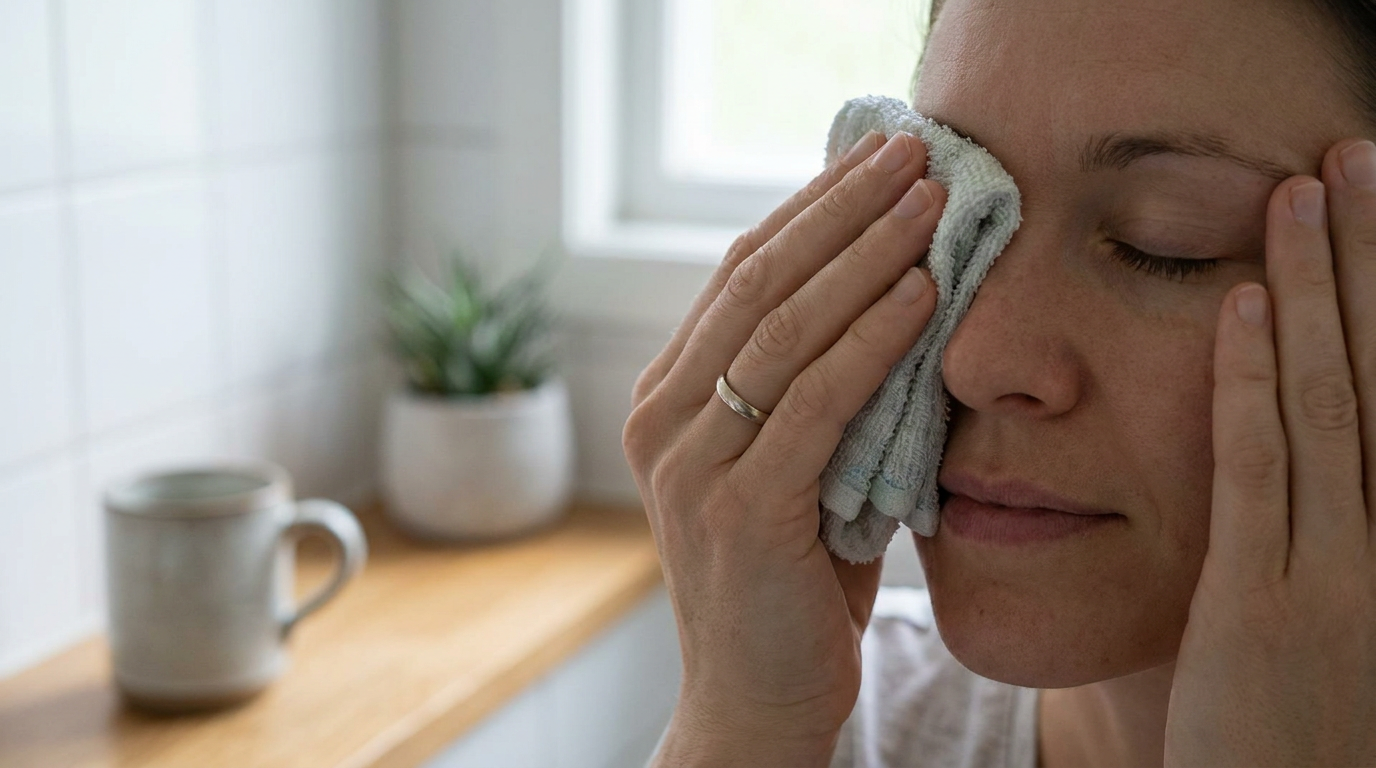
For the full morning and evening version—technique, sequencing, and how to fit it into a household that is already busy—see the daily eyelid hygiene routine every family should know.
The evidence base for lid hygiene continues to develop. A randomized trial published in Scientific Reports in July 2026 compared preformulated cleansing wipes, 0.01% hypochlorous acid, and saline across 72 adults using them twice daily for four weeks. Wipes significantly outperformed saline on symptom scores, but were not shown to be superior to hypochlorous acid—the comparison between the two active approaches did not reach statistical significance. It is a single-center study and should be read as supporting evidence beneath established guidance, not as a verdict.
This is also the honest answer for anyone searching how to manage blepharitis at home or naturally. Home care is not a lesser substitute for the real thing here—daily eyelid hygiene is the frontline approach, and it happens at your bathroom sink.
Which makes consistency the variable that matters most. Ten focused days followed by three weeks of nothing will not do what five unremarkable minutes every day will. The AAO’s own framing puts compliance at the center of successful management. Think of it the way you think of brushing your teeth—unremarkable, quick, and quietly load-bearing.
When you are ready to look at options, our eyelid and lash cleansers are formulated for exactly this kind of daily use.
Which raises the obvious next question: which type of cleanser?
Choosing the Right Eyelid Cleanser: Hypochlorous Acid vs. Tea Tree Oil
Hypochlorous acid (HOCl) cleansers provide broad antimicrobial action on the lid margin, while tea tree oil cleansers—specifically their active component terpinen-4-ol (T4O)—are the agents directed at Demodex. Because each addresses what the other does not, eye care professionals often use them alongside one another rather than choosing between them.
Hypochlorous acid has unusually strong third-party support for a consumer category. The AAO Preferred Practice Pattern states that eye cleaners with hypochlorous acid at 0.01% “have a strong antimicrobial effect which has been used for the treatment of both anterior and posterior blepharitis.” That is the field’s leading guideline document describing an ingredient category—not a marketing claim about any particular bottle.
Supporting trial data exists too. Mencucci and colleagues (2023), in BMJ Open Ophthalmology, randomized 48 blepharitis patients to an HOCl hygiene solution or hyaluronic acid wipes for four weeks. Tear film break-up time improved significantly in the HOCl group but not the comparator group, while symptom scores and meibum quality improved in both. Bacterial load on the lid margin fell by an average of 90.3% with HOCl compared with 62.1% with the comparator wipes.
Avenova Lid & Lash Cleansing Spray is a hypochlorous acid lid and lash spray used as part of a daily eyelid hygiene routine.
Tea tree oil and T4O occupy the other half of the picture. T4O is the isolated active component of tea tree oil, used in formulation because it reduces irritation relative to whole tea tree oil. The AAO notes that tea tree oil scrubs used for a minimum of six weeks showed improvement in a small case series of patients who had not improved on conventional approaches.
The complementarity is where the clinical logic sharpens. The AAO also notes that hypochlorous acid has minimal effect on Demodex. These two ingredient categories are therefore not redundant—they act on different things on the lid margin, which is precisely why practitioners often pair them.
| Hypochlorous Acid (HOCl) | Tea Tree Oil (T4O) | |
|---|---|---|
| What it does | Broad antimicrobial action on the lid margin | Directed at Demodex on the lid and lash |
| Best suited for | Daily maintenance across anterior and posterior forms | Lid margins where collarettes are present |
| Effect on Demodex | Minimal, per AAO | The category directed at mites |
| Key consideration | Gentle enough for routine daily use | Concentration and formulation matter for tolerability |

One caution belongs here, prominently. A Cochrane review found the quality of evidence for blepharitis interventions to be uncertain, and tea tree oil carries documented risks of ocular surface irritation and epithelial defects—particularly at high concentrations such as the 50% solutions used in some early case series, and where tolerability is poor. Never apply undiluted tea tree oil near your eyes. This is exactly why a properly formulated, buffered consumer product is the appropriate choice over anything improvised at home. The EyeEco Tea Tree Eyelid & Facial Cleanser, Gentle is formulated for daily use on the lid and lash area, with Advanced and Age Defying formulations also available.
Cliradex Light Foam and Cliradex Towelettes are additional T4O options, covered in depth in our Cliradex guide.
Home care has limits, though. Here is where they are.
When to See an Eye Care Professional About Blepharitis
See an eye care professional if symptoms persist despite several weeks of consistent daily eyelid hygiene, if you experience eye pain, vision changes, significant swelling, or light sensitivity, if you develop recurrent styes, or if you are simply unsure whether what you have is blepharitis at all.
Book an appointment when you notice:
- Symptoms persisting after several weeks of consistent daily care
- Eye pain or vision changes
- Significant eyelid swelling
- Marked light sensitivity
- Recurrent styes or chalazia
- Lash loss or lashes growing inward
- Any uncertainty about what you are dealing with
Self-assessment has a genuine ceiling here. Demodex blepharitis is diagnosed clinically—an eye care professional identifies collarettes at the lash base during a slit lamp exam, at a magnification no bathroom mirror provides.
Prescription options also exist. Lotilaner ophthalmic solution 0.25% (XDEMVY) was approved by the FDA in July 2023 as the first prescription drug specifically indicated for Demodex blepharitis, dosed twice daily for six weeks. In the Phase 3 Saturn-1 and Saturn-2 trials, it produced significant collarette reduction and improvement in lid margin erythema versus vehicle. EyePromise does not sell this product; it is simply a matter to discuss with your eye care professional if it seems relevant to your situation.
Worth knowing regardless of route: maintenance hygiene is still part of the picture afterward, because mites can return. The daily habit does not become obsolete.
The best outcomes come from partnership—daily care at home, professional guidance when you need it. If you are already thinking about scheduling, our eye health checklist is a useful thing to bring along.
A few specific questions remain.
Frequently Asked Questions About Blepharitis
Is blepharitis contagious?
No. Blepharitis is not contagious. You cannot pass it to family members through close contact, shared towels, or shared pillows. It develops from factors on your own eyelids, including bacteria, oil gland function, and skin conditions such as seborrheic dermatitis or rosacea.
Is Demodex blepharitis contagious?
Demodex mites are normal residents of human skin, present in most adults without causing problems. Demodex blepharitis is generally not considered a contagious condition, and it is diagnosed clinically by an eye care professional based on collarettes at the lash base.
How long does blepharitis last?
The American Academy of Ophthalmology describes blepharitis as typically a chronic condition that cannot be permanently cured. Symptoms commonly improve within weeks of consistent daily eyelid hygiene, but the condition is relapsing and symptoms often return if daily care stops.
Does blepharitis cause blurry vision?
It can cause brief blurring that clears when you blink, because an unstable tear film scatters light across the eye’s surface. Vision changes that persist, worsen, or do not clear with blinking should be evaluated promptly by an eye care professional.
Can blepharitis cause headaches?
Some people report headaches or brow tension alongside blepharitis, often linked to eye strain, squinting, and light sensitivity rather than the lid inflammation itself. Persistent or severe headaches warrant evaluation by a healthcare professional to rule out other causes.
Can blepharitis cause styes?
Yes. Blocked or inflamed glands along the eyelid margin can develop into styes or chalazia, and recurrent styes are a recognized feature of ongoing lid margin inflammation. Repeated styes are a clear signal to see an eye care professional.
How do you prevent blepharitis flare-ups?
Consistency is the main lever: daily eyelid hygiene performed year-round rather than only during flares, removing eye makeup nightly, managing related skin conditions, and following your eye care professional’s guidance. Explore eyelid and lash cleansers formulated for daily use.

The Takeaway: Manageable, Not Mysterious
Blepharitis is common, chronic, and manageable. A cure is generally not on the table—but meaningful, lasting improvement is, and it comes from something you already control.
Reframe “daily and indefinite” and it stops sounding daunting. This is five quiet minutes at the sink, not a battle. A small habit, repeated, doing steady work in the background.
Daily hygiene at home, professional guidance when you need it. That partnership is where comfortable eyes, clear vision, and all the moments they make possible come from.
Explore cleansers formulated to support a daily eyelid hygiene routine, developed alongside the eye care professionals who see these lids every day.
Science Backed. Doctor Trusted. Patient Approved.
