


At a Glance:
- The clocks change and your commute moves into the dark. The drive is the same. The light is not.
- A lower sun angle means direct glare in the late afternoon, not only headlight glare after dark.
- Wet asphalt reflects light instead of scattering it, and the glass beads in lane markings lose their retroreflectivity under a film of water.
- Pupils widen in low light, admitting more light through the outer edges of the lens, where it is focused less precisely.
- Some of that light scatters on the way in and spreads across the retina as a veil. That is why a point of light looks like a starburst, and why halos appear around it.
- After a bright light passes, the retina needs time to reset. That interval is photostress recovery, and it tends to lengthen with age.
- Contrast sensitivity — telling dark grey from black — is a separate measure the standard eye chart does not test.
- Trouble seeing at night can persist with a perfect prescription, because lenses act only at the focusing step.

It is 5:15 on a Tuesday in early November. You are on the same road you have driven for years — the one with the long bend before the intersection, the one you could describe with your eyes closed. Except it is dark now. It was not dark at this hour three weeks ago. The pavement is wet from an afternoon of rain that never quite committed, and the surface has taken on a black gloss that throws every light source back at you twice.
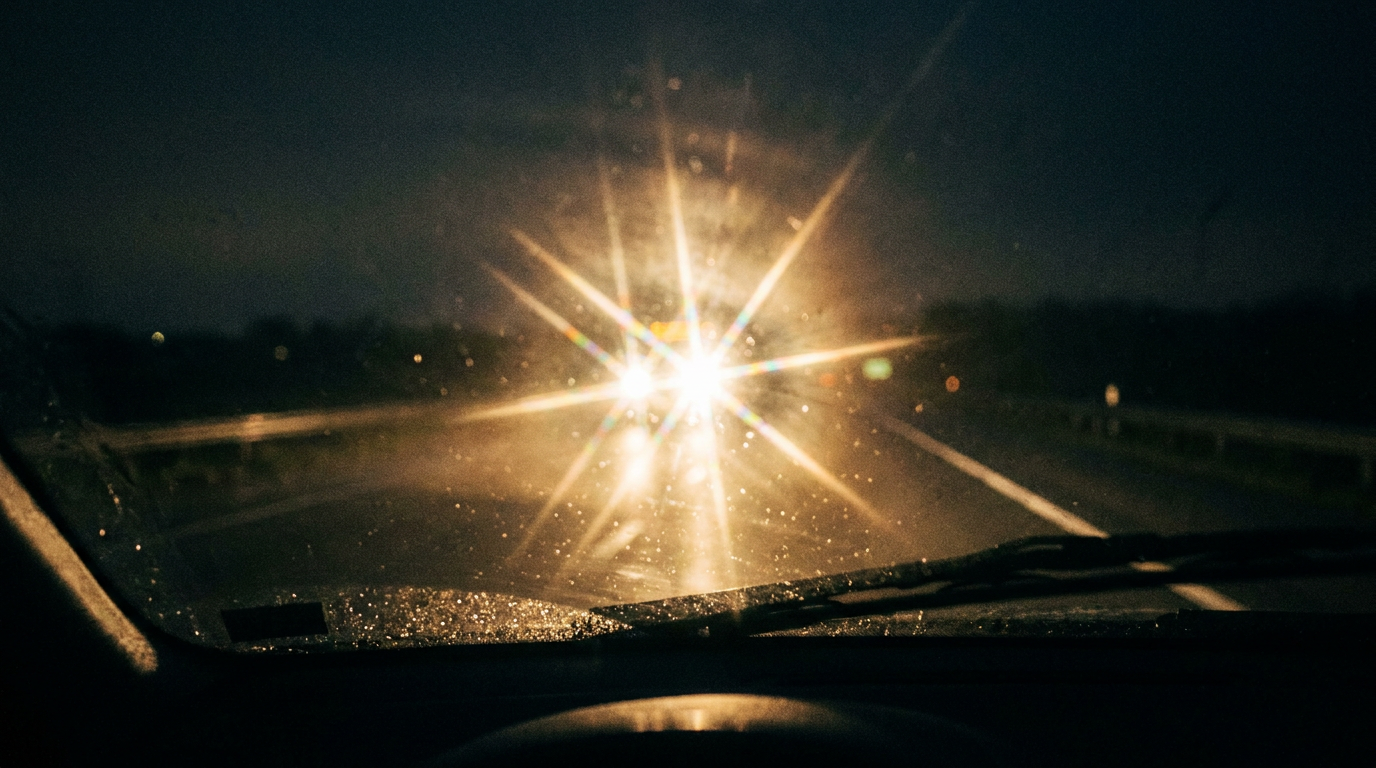
A car comes the other way. The headlights do not stay where they belong. They bloom outward into spokes and rays, wider than the car itself, and for a moment the whole left side of your windshield is a smear of white. The car passes. There is a beat — a half-second, maybe longer — where the road ahead is simply gone. Not dim. Gone. Then it comes back.
And when it comes back, the lane markings look soft. Washed out. You know they are there, and you can follow them, but they are not the crisp white lines they are at noon. You find yourself sitting a little more forward in the seat.
If you have noticed this, that is worth saying plainly: noticing is a good sign. It means you are paying attention to your vision with the same care you would give any other instrument you depend on. Most people who notice a change like this assume the worst thing first. The far more likely explanation is that several ordinary things have changed at once — some outside the car, some inside your eye — and they have changed at the same time of year.
This article walks through both.
Contents
- The Short Answer
- Four Things Change When the Clocks Do
- The Starburst Around Headlights
- The Beat of Near-Blindness After a Car Passes
- Seeing the Difference Between Dark Grey and Black
- I Just Need New Glasses
- A Natural Filter at the Back of Your Eye
- What Else Compounds It
- What to Ask at Your Next Eye Exam
- Frequently Asked Questions
- The Season Changed, and So Did the Drive
- Where to Start
The Short Answer
Night driving glare worsens in fall and winter because darkness arrives during rush hour, the sun sits lower, and wet roads scatter headlight beams. Your pupils open wider in low light, magnifying starbursts and halos.
Recovery after an oncoming car passes also slows with age, independent of your glasses prescription.
The rest of this page separates those pieces into two groups: the ones that are about the season and the road, and the ones that are about the eye. That distinction matters, because the two groups call for very different responses.
None of what follows means something is wrong. It means several ordinary things arrive at the same time of year and stack on top of one another.
Four Things Change When the Clocks Do
Your Commute Moves Into the Dark
The drive did not change. The light did.
A commute that happened comfortably in daylight in mid-September happens in full darkness by early November. Nothing about your route, your car, or your driving is different. The sun simply sets earlier, and then the clocks move, and a stretch of road you have navigated a thousand times in the light becomes a stretch of road you navigate in the dark.
What makes this particularly demanding is the overlap. The heaviest part of the evening traffic day now coincides with the most visually complicated part of it. Headlights, brake lights, wet reflections, illuminated shop signage, and turn signals all compete for attention in the same field of view, at the same moment, with no daylight to give any of it context. The eye is being asked to sort a great deal of information out of very little ambient light.
It is worth sitting with the implication. You did not become a worse driver over the course of three weeks. The conditions changed abruptly, on a calendar date, and your experience of the drive changed with them. The Federal Highway Administration treats reduced visibility during evening light transitions as a recognized roadway condition in its nighttime visibility overview—which is to say, this is a documented property of roads in the dark, not a private failing.
The Sun Sits Lower
Glare in these months is not exclusively a nighttime problem, and this surprises people.
In autumn and winter the sun tracks a lower arc across the sky. For part of the afternoon commute it is not overhead—it is sitting directly in your line of sight, low on the horizon, aimed straight down the road you are driving. A visor helps at certain angles and is useless at others. Sunglasses help with brightness but not with the sun’s position.
Low-angle sun does something else, too. It throws long shadows across the roadway from buildings, overpasses, and bare trees. The result is a road surface striped with alternating patches of bright and dark, and your eyes have to re-adjust to each transition as you pass through it. That constant readjustment is work. By the time the sun is fully down and the headlights come on, the visual system has already had a demanding hour.

Wet and Icy Asphalt Behaves Like a Mirror
This is the single most underappreciated factor in the whole picture, and it has almost nothing to do with your eyes.
Dry asphalt is rough at a microscopic scale. When headlight beams hit it, that roughness scatters the light in many directions, and only a small portion travels onward toward other drivers. Add water, and the physics change. A film of water fills in the surface texture and creates a smooth layer on top, and a smooth surface at a shallow angle reflects light rather than scattering it. The road stops behaving like sandpaper and starts behaving like a mirror, sending headlight beams forward into the eyes of oncoming drivers instead of dispersing them harmlessly.
The same water film degrades the lane markings, and this is where roadway engineers have done the clearest work. Painted markings are not simply white paint—they contain tiny glass beads that bend incoming headlight and return it toward its source, which is why lines seem to glow when your headlights find them. Cover those beads with water and the optics fall apart. The light no longer passes from air directly into glass, so it bends differently and misses the reflective surface behind the bead. Smaller beads are submerged entirely. Federal Highway Administration research on wet-reflective pavement markings documents this loss of return in detail, and separate FHWA guidance on driver and roadway characteristics in wet weather confirms that reflections off wet pavement degrade what a driver can see.
Read that again, because it reframes the experience: on a wet night, the road is delivering you less usable information while simultaneously aiming more light at your eyes. Ice, slush, and the spray thrown up by the vehicle ahead of you add further scatter, effectively multiplying every light source on the road.
Your Pupils Open Wider in Low Light
The last environmental factor happens inside the eye, but it is still ordinary optics.
In dim conditions the pupil opens to admit more light. This is the eye doing precisely what it is built to do, and it is the reason you can see anything at all on an unlit road. But every aperture involves a trade-off, and this one is straightforward: a wider opening lets light enter through the outer edges of the eye’s lens as well as through the center. Light that comes in near the periphery is not focused as precisely as light that comes through the middle.
So more light gets in, and more distortion comes with it. A single bright point—an oncoming headlight—can spread into a halo or fan out into a spray of spokes at night, and then look perfectly crisp to the same eye in daylight, when the pupil has narrowed and only the well-behaved central light is being used. The American Academy of Ophthalmology’s EyeWiki reference on pupil size and intraocular light scatter describes this relationship between larger pupils and increased scatter.
Worth stating plainly: this happens in eyes that have never had surgery, have never had a procedure, and have nothing unusual on the chart. It is optics, not pathology.
That accounts for the season and the road. Now for what is happening inside the eye—starting with the sensation you almost certainly came here to name.
The Starburst Around Headlights
An oncoming headlight, at night, is not a dot.
Look directly at one and it resolves into something with structure — a bright center with spokes radiating out from it, sometimes a soft ring or halo surrounding the whole thing, sometimes a full starburst that seems to extend well past the physical width of the lamp. Different people see different shapes. Some see a symmetrical burst, some see rays pulled to one side, some describe a general bloom with no defined edges at all.
None of that shape is out there on the road. The headlight is a small, contained source. The structure is being produced inside your eye.
Here is the mechanism. Light entering the eye passes through the tear film, the cornea, the lens, and the vitreous before it reaches the retina. Each of those is remarkably clear, but none is perfectly clear, and clarity changes over a lifetime. Where the light encounters any irregularity, a portion of it deviates from its intended path. Instead of arriving at a single point on the retina, that portion spreads out across a wide area as a low-level veil of light.
That veil is the problem. It does not simply make the headlight look bigger. It lays a wash of light over everything near it — including the lane line, the shoulder, the pedestrian at the crosswalk, the dark shape of a deer at the tree line. The objects you need to see are still forming images on your retina. They are just doing it underneath a layer of stray light that reduces the difference between them and their background.
Clinicians call this glare disability: not discomfort from a bright light, but measurable loss of visual function caused by scattered light. And the crucial detail — the one that explains nearly everything that follows — is that this scatter happens on the way in. It happens to the light before it ever reaches the retina, before the image is formed at all. It is a problem of the journey, not the destination.
Hold onto that. It is the reason the next several sections make sense.
The Beat of Near-Blindness After a Car Passes
The car goes by. For a moment, the road is not dim — it is absent. Then it returns.
That interval has a name, and it describes a real physiological event rather than a subjective impression. The light-sensitive cells in your retina work through photopigments that respond to light by changing chemically. A bright light bleaches those photopigments. Until they regenerate, the affected patch of retina cannot respond normally to what comes next. The recovery interval is called photostress recovery time.
Everyone has one. What varies is how long it lasts.
This is where an assumption tends to get in the way. Most people, told that their vision goes briefly blank after a bright light, conclude that their prescription must be off. The evidence points elsewhere. The American Academy of Ophthalmology’s EyeWiki entry on the Photostress Recovery Test notes that recovery time is not well explained by pupil size, refractive error, or baseline visual acuity — meaning a person with flawless 20/20 vision and a current prescription can still have a long recovery. [WEB TEAM: re-attach AAO EyeWiki Photostress Recovery Test URL from the source document.]
Recovery time also tends to lengthen gradually with age. Not dramatically, and not on any schedule you could mark on a calendar. But a recovery interval that was brief enough to go unnoticed at thirty-five can become long enough to register at fifty-five — and long enough to matter on a two-lane road where cars pass every few seconds.
You can observe your own, informally, without any equipment. The next time a car passes you at night, notice how long it takes before the lane line looks normal again. Do not time it with anything. Just notice whether it is a flicker or a genuine pause, and whether it feels the same as it did a few years ago. That observation is worth bringing to an eye exam, and it is the kind of thing no one asks you about unless you raise it.
Scatter happens before the image forms. Recovery happens after. There is a third mechanism, and it concerns how well you can distinguish an object from its background even when nothing is bleached and nothing is scattering.
Seeing the Difference Between Dark Grey and Black
Night driving is almost never a test of how small a thing you can see. It is a test of how well you can separate a dark thing from a slightly less dark thing.
A pedestrian in a navy coat against wet blacktop. A curb against the shoulder. The faded edge of a lane line. A cyclist without lights. None of these are small. All of them are low-contrast — the object and its background sit near each other on the scale from black to white, and the visual work is telling them apart.
That capacity is contrast sensitivity, and it is a distinct measurement. It is not what the standard eye chart tests. The chart uses high-contrast targets — black letters on a bright white background — under good, even lighting, and it measures the smallest one you can identify. It is a genuinely useful test, and it answers a specific question well. It simply does not answer this one. A clinical overview hosted by the National Institutes of Health through StatPearls describes contrast sensitivity as a separate function that can decline while high-contrast acuity remains normal. [WEB TEAM: re-attach NIH-hosted StatPearls contrast sensitivity URL from the source document.]
This is how someone leaves an eye exam with a clean result and drives home that night feeling like something is wrong. Both experiences are accurate. They are measuring different things.
Now layer this back onto the wet road. The water film has already dimmed your lane markings by defeating the retroreflective beads. The oncoming headlights have already laid a veil of scattered light over the scene, further compressing the difference between the line and the pavement. Reduced contrast sensitivity meets an environment that has independently reduced the available contrast.
That is not three separate problems having a bad night together. That is one situation, with three inputs, arriving at the same moment on the same road. And it explains why the difficulty feels so specific — why it shows up on a wet November evening and not in a parking garage, not on a dry summer night, not on the eye chart.
Which raises the question you have probably been holding since the first paragraph.
I Just Need New Glasses - Why the New Prescription Didn't Fix It
You probably already did the responsible thing. You noticed the glare, concluded that your prescription must be out of date, booked the appointment, and got new lenses. And the starbursts are still there.
Let us be clear about something first: that was the correct move. Updating a prescription is exactly what you should do when your vision changes, and this section is not going to tell you that you wasted your time or your money. You did the right thing. It just did not solve this particular problem, and there is a specific, satisfying reason why.
A prescription does one job, and it does it precisely. It corrects where light comes to a focus. If light entering your eye is landing slightly in front of the retina or slightly behind it, lenses reposition that focal point so it lands where it should. That is a real, valuable, measurable correction, and it is the reason road signs are sharp instead of fuzzy.
Now the pivot, stated plainly. A prescription does not change how much light scatters on the way in. And it does not change how quickly the back of your eye recovers after a bright light passes. Those are two different mechanisms, and lenses do not act on either one.
Look at how the pieces from the last two sections assemble. Scatter happens before focus—light is already spreading as it travels in. Recovery happens after focus—the cells at the back reset once the light has arrived. A lens works at the focus step, sitting neatly in between. It is doing its job with real precision. Its job simply happens to sit directly between the two things bothering you most.
This is also why the two sourced findings from earlier matter so much here. Recovery after a bright light is not well explained by refractive error, per the AAO EyeWiki Photostress Recovery Test entry. And a clean, even excellent, result on the eye chart can coexist with genuine difficulty in low-contrast evening conditions, per the contrast sensitivity literature. Your new glasses did not underperform. They were never the tool for these two jobs.
What about anti-reflective coating? It works. Genuinely.
Anti-reflective coating cuts the reflections that bounce off the front and back surfaces of the lens itself—the ghost images and secondary halos created by the eyeglasses rather than by your eyes. On a dark road surrounded by headlights, that is a meaningful reduction in visual clutter. It is worth having, it is worth paying for, and if you are ordering new lenses you should not skip it. Nothing in this article should be read as talking you out of it.
But it works on the outside of the eye. It operates on the surface of a lens sitting an inch in front of your face, and it cannot reach the scatter that occurs inside the eye, after light has already entered. Two different locations. Two different problems. The coating solves the one it can reach, completely and well.

A Natural Filter at the Back of Your Eye
There is a small area at the very back of your eye responsible for sharp, central, detailed vision. It is the part you are using right now to read this sentence, and the part you use to pick a lane line out of wet asphalt.
Sitting over that area is a layer of naturally occurring yellow pigment. It functions something like a built-in pair of sunglasses positioned exactly where it would be most useful—absorbing a portion of scattered, short-wavelength light before it can wash across the detail-sensing cells underneath. Not a barrier. A filter.
That layer is called macular pigment, and its thickness can be measured. The measurement is known as macular pigment optical density, or MPOD.
What the pigment is made of is the interesting part. It is built from dietary carotenoids—principally lutein and zeaxanthin. Your body does not manufacture them. Every molecule of that filter arrived through what you have eaten.
Which leads to the point that makes this section worth your time: density varies significantly from person to person. Two people the same age, with the same prescription and the same clean exam, can have meaningfully different densities, and that variation tracks with dietary intake, as documented in research on macular pigment optical density and dietary intake. This is the reason it belongs in this article at all. You cannot influence the calendar, the sun’s angle, the wetness of the road, or the passage of time. This one is different.
Researchers have looked at macular pigment in relation to the very visual functions described earlier in this article—contrast sensitivity, recovery after bright light exposure, and comfort with glare. A meta-analysis hosted by the NIH on lutein and zeaxanthin intake and macular pigment optical density describes the pigment’s filtering role and the relationships that have been examined. This is an area of active study, and it is more honest to describe it that way than to promise you an outcome.
This is also the point where it makes sense to mention what we make. EyePromise Restore is our replenishment tier: targeted nutritional support for adults noticing early age-related visual changes who have not been told by a doctor that they have macular changes. Think of it as replenishment, not correction.
- Dietary zeaxanthin and lutein in a 2:1 ratio, matching the macula’s own natural composition
- Zeaxanthin sourced from U.S.-grown paprika peppers; lutein from marigold
- rTG omega-3s, vitamin D3, B vitamins (B6, B9, and B12), CoQ10, alpha lipoic acid, and antioxidants
- NSF Certified, made in the USA, and built on a patented formula
- Recommended by more than 8,500 eye care professionals
Restore supports contrast and glare sensitivity, helping you feel more comfortable in challenging lighting, like night driving. It replenishes nutrients aging eyes naturally lose, defends the macula from oxidative stress, and supports the visual clarity needed for reading, driving, recognizing faces, and seeing fine detail. If you want the underlying science rather than the product page, our Vital Nutrition for Aging Eyes page is the better destination.
One honest note about expectations, because you deserve it up front: nutritional support works gradually, over months rather than days. Anyone who tells you otherwise is selling something differently than we would like to.
And if an eye care professional has already mentioned early macular changes to you, they may suggest a different level of support. That conversation belongs with them, not with an article.
Macular pigment is one contributor among several, so here are the others that commonly stack on top.
What Else Compounds It
An unstable tear film. The tear layer is the very first surface light passes through on its way into your eye. When that layer is uneven or breaks up quickly between blinks, light begins scattering before it has technically entered the eye at all. Occasional dryness and irritation along the lid margin can both play a role. EyePromise offers products in eye hydration and eyelid and lash care, and our eye hydration routine page walks through the basics.
A full day on screens before an evening drive. Sustained near-focus work leaves the visual system fatigued. Then the commute home asks that same tired system to perform the single hardest task of its day, in the dark, in the rain. EyePromise has products in the visual performance category.
Routine dilated exams for adults managing Type 2 diabetes. If you are managing Type 2 diabetes, keep your routine dilated eye exams on schedule as advised by your care team. It is straightforward scheduling guidance, and it is worth putting on the calendar.
These factors tend to stack, which is exactly why an evening drive can feel disproportionately harder than any single one of them would suggest on its own.
What to Ask at Your Next Eye Exam
It is common to put off an eye exam when something feels off. The logic is understandable—not knowing feels easier than knowing, at least for a while.
Consider flipping it. Booking the appointment is the move that puts you back in control of the situation. It is the confident action, not the worried one. You are not going in to receive news; you are going in with specific observations and specific questions, which is a fundamentally different posture.
And it is worth repeating what this article has established: most of what is described above is ordinary, expected, and explainable. Going in with specifics simply lets an eye care professional sort out which parts are which.
Then there is the part that will improve your appointment more than any question: describe situations, not general complaints.
Compare the two. “My night vision is bad” gives a clinician almost nothing to work with—it could mean a dozen different things with a dozen different explanations. Now compare: “On wet roads, oncoming headlights spread into spokes, and it takes me a few seconds before I can see the lane markings again.” That second version hands them something specific to investigate. It points at mechanisms. It is the difference between reporting a feeling and reporting an observation.
Note when it happens, too. Which roads. What weather. What time of day. Whether it is noticeably worse when you are tired at the end of a long week. Patterns are diagnostic gold, and you are the only person who can collect them.
The goal here was never simply to see well enough to survive the drive. It is to keep doing the ordinary evening things that make up an actual life—driving to dinner in November, picking someone up from the station, getting home in the dark without thinking twice about it.
Frequently Asked Questions
Is night driving glare normal after 50?
Some increase is common with age. Pupils respond differently in low light, and the retina takes longer to recover after a bright source passes. Persistent or sudden changes are worth raising at your next eye exam.
Why is glare worse in the rain?
Wet asphalt reflects headlight beams instead of absorbing them, scattering light across your field of view. Add spray and a wet windshield, and the same headlight reaches your eye from several directions at once.
Do anti-glare glasses help with night driving?
Anti-reflective coating reduces reflections off the lens surface, which genuinely helps. It doesn’t change how light scatters inside the eye or how quickly your retina recovers — those aren’t refractive, so lenses can’t reach them.
Can lutein help with night driving?
Lutein and zeaxanthin concentrate in the macula and act something like internal sunglasses, filtering scattered light. Density varies between individuals and is influenced by diet. Ask your eye doctor whether they measure macular pigment optical density.
When should I see a doctor about night driving glare?
Book an exam if glare is new, worsening, or changing how you drive. Sudden changes, halos with eye pain, or vision loss warrant prompt attention. Bringing specific examples helps your doctor more than general descriptions.
Where to Start
If you would like a next step, here are five, in no particular order of urgency.
- Discover our products. EyePromise Restore is formulated with dietary zeaxanthin and lutein, the carotenoids that make up macular pigment.
- Take the eye care quiz if you are not sure which formula fits your situation.
- Bring the three questions — MPOD, contrast performance, and recovery time after bright light — to your next appointment, whether or not you do anything else on this list.
- Check your HSA/FSA eligibility. Many EyePromise products qualify, and unused funds often expire at year end.
- Read more about EyePromise if you want to know who makes this and why.
These statements have not been evaluated by the Food and Drug Administration. This product is not intended to diagnose, treat, cure, or prevent any disease.